Jared is one of the premier student organizers in the country. I met him at the National Resources Council of Maine's annual meeting. I mainly talked with him about the Climate Action Club, but he let me ask him my I-Search question. He gave me an answer that I had not found during my research.
First all, he started by saying how global warming can't become the central cultural issue of my generation. Jared said that this wasn't possible if we just talked about fighting climate change. He said that we had to act and do something to stop global warming.
Jared then went on to say that global warming needs to "be part of a vision that speaks to other cultural issues." He also said that "global warming is part of an anxiety that people feel." But, the true root of these feelings is how fast our world is changing. People have "more concern for economic opportunity." Jared concluded by saying that if you connected climate change to a sense of economic anxiety, then it can become more of a central issue. It needs to be a "national effort," and we need to focus on new technologies like "wind and solar power." Jared stressed that we "need to move away from fossil fuels." It is vital to "connect people's aspirations for a better economy."
I completely agree with Jared's answer. It is also very different from any other conclusion that I have come to. I definitely think that connecting global warming to the economy will be a major step towards making it one of the central cultural issues of our generation.
I am very aware that there are other vital issues in our world today. Famine, war, disease, and so much more. But, I think that the environment should be an extremely prominent issues because all of our current problems will seem small compared to what will happen if we do not fight global warming. I think this is a very important point for people to understand when they read this blog and start to take a stance against climate change.
Jared included a quote by John Kenneth Galbraith in this interview. "All of the great leaders have had one characteristic in common: it was the willingness to confront unequivocally the major anxiety of their people in their time. This, and not much else, is the essence of leadership.” It directly speaks to what Jared told me.
Friday, February 8, 2008


Wednesday, February 6, 2008
The Week article
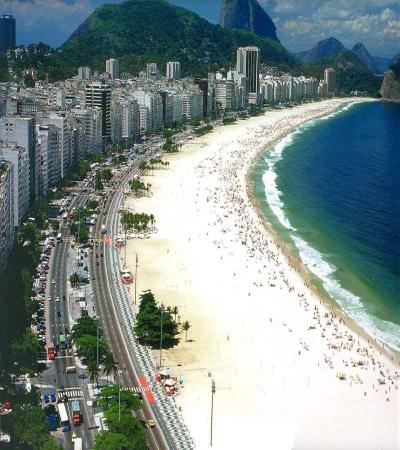
This is a very brief article in the Health and Science section of The Week magazine. The basis for this article is historic: "By examining ancient sea sediments, the scientists were able to reconstruct conditions between the last two ice ages, 124,000 years ago. During this period, temperatures rose by about 4 degrees Fahrenheit, and the ice in the arctic regions melted rapidly, adding vast quantities of water to the oceans. Today, a sea-level rise of that magnitude would be catastrophic." This shows how scientists are using previous hot periods to predict what is in our future. But, as so many people know, the past decade has had unnatural temperature increases that are clearly human-caused. Therefore, whatever happened in the past will most likely be worse in the future. Many towns and cities are on the coast, and they depend on their unique position and culture. But, as the threat of rising seas increase, these are at risk. Millions of people flock to seaside villages and cities for vacations. These beautiful places may cease to exist in a few decades. I talked about this point in the context of another source. I still think that this is a reason why people will decided to fight global warming: most simply, what they love is at stake.
The Revenge of Gaia
There is a whole section in this book explaining what Gaia is. In scientific terms, Gaia is "a thin spherical shell of matter that surrounds the incandescent interior... I call Gaia a physiological system because it appears to have the unconscious goal of regulating the climate and the chemistry at a comfortable state for life" (Lovelock 15). Therefore, Gaia is "'the living earth'" (Lovelock 16).
This book is very blunt and straightforward, clearly stating the true reality of global warming. I think that it is a little excessive. But, I also think this is what is needed for people to snap into reality. I found a lot of great information in this book. I will quote what I found, and then comment on the text.
"The planet we live on has merely to shrug to take some fraction of a million people to their death. But, this is nothing compared with what may soon happen; we are now so abusing the Earth that it may rise and move back to the hot state it was in fifty-five millions years ago, and if it does most of us, and our descendants, will die" (Lovelock 1). This passage refers to the earth as a living creature, which relates back to the concept of Gaia. We have to think of our planet as a creature whom we are abusing. We depend on the land and the environment to sustain us. Once this basic structure of our lives is gone, we will be lost and helpless. This point of view can be key to mobilizing people to act. Thoughts, feeling, and appreciativeness is another component to my answer. These reasons are why I have become so passionate about nature. This excerpt, for me, is why we need to repair our beloved earth. Not many people realize what danger and change lies ahead if we don't do something now. Also, we need to think about our descendants. If the world's habits do not change, then we will be leaving this incredible mess for our children. This is just not fair. From experience with other environmentalists, this is a key motivational factor.
"...many...still regard global warming as a fiction...In truth, neither faith in God nor trust in business as usual...acknowledges our true dependence; if we fail to take care of the Earth, it surely will take care of itself by making us no longer welcome" (Lovelock 2). This passage holds a lot of truth. We can not depend on a single class our group of people, even God, to fight global warming. This movement must be international. Otherwise, nothing can be done. Another answer to my question is truth. If people really know what is going on, then maybe they will do something. But, without sufficient knowledge, how can they be expected to act?
I think that different people will be motivated to fight global warming for different reasons. Some will respond to facts, others to government action. But, one way or another, the people of this Earth need to unite under a single cause: saving our planet.
Lovelock has an interesting theory as to why we haven't really payed attention to global warming. "I think that we reject the evidence that our world is changing because we are still...tribal carnivores. We are programmed by our inheritance to see other living things as mainly some to eat..." (Lovelock 4). I think that this is true to some extent. There are other reasons why people haven't accepted global warming, like laziness or misinformation. But, this is another aspect as well, and so another answer to my question.
This is the most thought-provoking and mind-blowing passage in this book: "Even if we stopped immediately all further seizing of Gaia's land ans water for food and fuel production and stopped poisoning the air, it would take the Earth more than a thousand years to recover from the damage we have already done, and it may be too late even for this drastic step to save us. To recover, even to lessen the consequences of our past errors, will take an extra-ordinary degree of international effort and a careful planned sequence for replacing fossil carbon with safer energy sources" (Lovelock 6). The last sentence is another component of my answer, and one that I have already touched on. International efforts are need to repair the damage that has been done, and they are a way to get people involved in this movement.
It is widely known that we are in a period in the history of the world that is record breaking. Nothing has ever been experienced before. "...nothing so severe has happened since...the Eocene, fifty-five millions years ago..." (Lovelock 7). This gives you can idea of how serious climate change is. Like I mentioned before, I think Lovelock is a bit excessive. Even still, we should act immediately because there is no time to lose.
Lovelock's major answer for our current climate crisis is nuclear power. He sees it "as the only effective medicine we have now...We must conquer our fears" (Lovelock 11). There has been much controversy over the safety of nuclear power. But, the author deeply believes that is affordable "sustainable development" (Lovelock 11). As I mention before, different answer to my question will apply to different people. Nuclear power may be a big solution in our future. Also, our dependency on fossil-fuels has to stop. This is very big step for people all over the world to take. But, new automobile energy is needed desperately for actions all over the world to make a substantial difference.
I agree with Lovelock when he says "The time of irreversible adverse change may be so close that it would be unwise to rely on international agreement to save civilization..." (Lovelock 13). Global warming will be fought by groups and individuals. Ultimately, the people, not the government, are the ones who are going to make sacrifices to save the environment. The policies may be made in the field, but the action will happen on the sidelines.
Fighting global warming is a major operation that will be on a scale never seen before. We are in unmapped territory. We cannot rely on the past to show us what the future holds. Our actions today will be history tomorrow. Like I have said so many other times, it is imperative that we act now. Only we can save ourselves. I know that it has hard for people to accept what the future holds and to change the way they live. But, this is a part of life that everyone must deal with. It is our time.
This book is very blunt and straightforward, clearly stating the true reality of global warming. I think that it is a little excessive. But, I also think this is what is needed for people to snap into reality. I found a lot of great information in this book. I will quote what I found, and then comment on the text.
"The planet we live on has merely to shrug to take some fraction of a million people to their death. But, this is nothing compared with what may soon happen; we are now so abusing the Earth that it may rise and move back to the hot state it was in fifty-five millions years ago, and if it does most of us, and our descendants, will die" (Lovelock 1). This passage refers to the earth as a living creature, which relates back to the concept of Gaia. We have to think of our planet as a creature whom we are abusing. We depend on the land and the environment to sustain us. Once this basic structure of our lives is gone, we will be lost and helpless. This point of view can be key to mobilizing people to act. Thoughts, feeling, and appreciativeness is another component to my answer. These reasons are why I have become so passionate about nature. This excerpt, for me, is why we need to repair our beloved earth. Not many people realize what danger and change lies ahead if we don't do something now. Also, we need to think about our descendants. If the world's habits do not change, then we will be leaving this incredible mess for our children. This is just not fair. From experience with other environmentalists, this is a key motivational factor.
"...many...still regard global warming as a fiction...In truth, neither faith in God nor trust in business as usual...acknowledges our true dependence; if we fail to take care of the Earth, it surely will take care of itself by making us no longer welcome" (Lovelock 2). This passage holds a lot of truth. We can not depend on a single class our group of people, even God, to fight global warming. This movement must be international. Otherwise, nothing can be done. Another answer to my question is truth. If people really know what is going on, then maybe they will do something. But, without sufficient knowledge, how can they be expected to act?
I think that different people will be motivated to fight global warming for different reasons. Some will respond to facts, others to government action. But, one way or another, the people of this Earth need to unite under a single cause: saving our planet.
Lovelock has an interesting theory as to why we haven't really payed attention to global warming. "I think that we reject the evidence that our world is changing because we are still...tribal carnivores. We are programmed by our inheritance to see other living things as mainly some to eat..." (Lovelock 4). I think that this is true to some extent. There are other reasons why people haven't accepted global warming, like laziness or misinformation. But, this is another aspect as well, and so another answer to my question.
This is the most thought-provoking and mind-blowing passage in this book: "Even if we stopped immediately all further seizing of Gaia's land ans water for food and fuel production and stopped poisoning the air, it would take the Earth more than a thousand years to recover from the damage we have already done, and it may be too late even for this drastic step to save us. To recover, even to lessen the consequences of our past errors, will take an extra-ordinary degree of international effort and a careful planned sequence for replacing fossil carbon with safer energy sources" (Lovelock 6). The last sentence is another component of my answer, and one that I have already touched on. International efforts are need to repair the damage that has been done, and they are a way to get people involved in this movement.
It is widely known that we are in a period in the history of the world that is record breaking. Nothing has ever been experienced before. "...nothing so severe has happened since...the Eocene, fifty-five millions years ago..." (Lovelock 7). This gives you can idea of how serious climate change is. Like I mentioned before, I think Lovelock is a bit excessive. Even still, we should act immediately because there is no time to lose.
Lovelock's major answer for our current climate crisis is nuclear power. He sees it "as the only effective medicine we have now...We must conquer our fears" (Lovelock 11). There has been much controversy over the safety of nuclear power. But, the author deeply believes that is affordable "sustainable development" (Lovelock 11). As I mention before, different answer to my question will apply to different people. Nuclear power may be a big solution in our future. Also, our dependency on fossil-fuels has to stop. This is very big step for people all over the world to take. But, new automobile energy is needed desperately for actions all over the world to make a substantial difference.
I agree with Lovelock when he says "The time of irreversible adverse change may be so close that it would be unwise to rely on international agreement to save civilization..." (Lovelock 13). Global warming will be fought by groups and individuals. Ultimately, the people, not the government, are the ones who are going to make sacrifices to save the environment. The policies may be made in the field, but the action will happen on the sidelines.
Fighting global warming is a major operation that will be on a scale never seen before. We are in unmapped territory. We cannot rely on the past to show us what the future holds. Our actions today will be history tomorrow. Like I have said so many other times, it is imperative that we act now. Only we can save ourselves. I know that it has hard for people to accept what the future holds and to change the way they live. But, this is a part of life that everyone must deal with. It is our time.
Tuesday, February 5, 2008
Mrs. Swazey
Chloe,
Very well done so far. You already have many sources and I like the way I can follow your thinking as you react to them. Might you want to consider some research into the psychology of motivation? Then you might apply research findings to your question. I think you'll find some interesting articles in Academic Search Premier.
Very well done so far. You already have many sources and I like the way I can follow your thinking as you react to them. Might you want to consider some research into the psychology of motivation? Then you might apply research findings to your question. I think you'll find some interesting articles in Academic Search Premier.
Monday, February 4, 2008
Mrs. Jewitt
I am very impressed with your blog and the combination of textual and visual information that you have chosen to include as you cull sources - keep digging for information that will help you best understand how to motivate others of your generation to make a difference in this area - Are there people that you could interview?
BBC Crops Source
This source focuses on how food shortage will affect people all over the world. A recent study suggested that "southern Africa could lose more than 30% of its main crop, maize, by 2030." Also, "The effects in these two regions could be catastrophic without effective measures to adapt to climate change." This is very important: adaptation. This is inevitable in our future. This quote shows how climate change doesn't have to overpower us: we can adapt to our new environment, change our behavior, and fix our climate. Water shortage, life, and crops can be saved with the proper action. We just need leaders who are willing to act. Once high-powered leaders become involved in the fight against global warming, others will follow. Therefore, people will act because of indirect reasons: the crops, water, and life are at risk. Politicians and activists become environmental leaders. The rest of the world follows. This thought process is the most important part of my answer so far.
The rest of this article is about how farmers will lose sorely needed money, and the agriculture society will fall apart, if crops continue to fail due to global warming. These effects will be felt all around the world. It is just one more reason why we need to act now.
The rest of this article is about how farmers will lose sorely needed money, and the agriculture society will fall apart, if crops continue to fail due to global warming. These effects will be felt all around the world. It is just one more reason why we need to act now.
Sunday, February 3, 2008
Water Management Source
Water shortage is already a major issue in our culture today. This article discusses how it will worsen as global warming increases. The most powerful line in this article is "'But climate change magnifies the possibility that the future will bring droughts or floods never seen in old measurements,' says Christopher Milly." In a world where prices are constantly increasing, this line should motivate anyone to act. Yet, I don't think that many realize the danger that we face. This is largely because people are too afraid to face it.
This article states that global investment in "water infrastructure" is more than "500 billions U.S. dollars." But, as people want to build more water utilities, they have to take into account the changing climate. This leads to even more spending and an unimaginable about of money. Water shortage will affect every single human being on the planet, both the rich and the poor. No water means no life.
This issue is already critical. But, I think the situation needs to become a little more serious for people to really realize what the future will hold. This is the plain hard truth. It is sad that the environment needs to be in such a bad state for people to realize what is at stake.
Another point that this article talks about is glacier melting. The most widely known effect of global warming is the melting of the Arctic glaciers. This will lead to flooding of many coastal town and villages all over the world. But, it also will mean more water. Therefore "Water availability will probably increase substantially in high latitudes of the northern Hemisphere." But, this is still a small portion of the world's land mass.
This article shows how serious global warming is, and how bad it can become. No matter how quickly we act now, there will be server long-term effects of climate change in the future. Humans have been careless, however unintentional. Now, we are paying the price. It is up to us to fix what we have started, and save the Earth that sustains us all. Like I said, with no water, there's no life. What fact could make people more aware of global warming? I think extreme water shortage could be a major answer to my question.
This article states that global investment in "water infrastructure" is more than "500 billions U.S. dollars." But, as people want to build more water utilities, they have to take into account the changing climate. This leads to even more spending and an unimaginable about of money. Water shortage will affect every single human being on the planet, both the rich and the poor. No water means no life.
This issue is already critical. But, I think the situation needs to become a little more serious for people to really realize what the future will hold. This is the plain hard truth. It is sad that the environment needs to be in such a bad state for people to realize what is at stake.
Another point that this article talks about is glacier melting. The most widely known effect of global warming is the melting of the Arctic glaciers. This will lead to flooding of many coastal town and villages all over the world. But, it also will mean more water. Therefore "Water availability will probably increase substantially in high latitudes of the northern Hemisphere." But, this is still a small portion of the world's land mass.
This article shows how serious global warming is, and how bad it can become. No matter how quickly we act now, there will be server long-term effects of climate change in the future. Humans have been careless, however unintentional. Now, we are paying the price. It is up to us to fix what we have started, and save the Earth that sustains us all. Like I said, with no water, there's no life. What fact could make people more aware of global warming? I think extreme water shortage could be a major answer to my question.
USA Today Source
The title of this article, "Warming Atlantic worsens hurricanes," backed up some of the answers I had already found for my question. As hurricanes become more violent, there are direct and serious threats to people who live on the coast. Increased global temperatures will produce hurricanes that the world has never seen. We can reduce this incredible risk by fighting global warming. Thousands of lives will be saved. Also, in the interest of government, millions of dollars will be saved. Less damage means less repair costs. These are the first thoughts that can to my mind when I read this title. I think that anyone who reads this will see the immediate danger people are in, and they will be compelled to act.
The opening paragraph shows how serious climate change affects the ferocity and frequency of hurricanes: "When the water in the hurricane breeding grounds of the Atlantic warms one degree in the dead of summer, overall hurricane activity jumps by half, according to a new study." If our global climate continues to rise as it is, "hurricane activity" will be overwhelming.
"...hurricanes get their enormous energy from warm waters, so the warmer the water, the more fuel a storm has to either start up or get stronger." This shows how global warming indirectly affects other aspects of our lives. There is evidence of this all over the world, especially in coastal areas.
This threat may move people to act. Confronting the loss of lives is a terrible tragedy that people will try to avoid. The best way to do this is to fight climate change. I think the risk of serious environmental events that can produce catastrophic results will force people to fight global warming. I think this is a key way for climate change to become a major cultural issue.
The opening paragraph shows how serious climate change affects the ferocity and frequency of hurricanes: "When the water in the hurricane breeding grounds of the Atlantic warms one degree in the dead of summer, overall hurricane activity jumps by half, according to a new study." If our global climate continues to rise as it is, "hurricane activity" will be overwhelming.
"...hurricanes get their enormous energy from warm waters, so the warmer the water, the more fuel a storm has to either start up or get stronger." This shows how global warming indirectly affects other aspects of our lives. There is evidence of this all over the world, especially in coastal areas.
This threat may move people to act. Confronting the loss of lives is a terrible tragedy that people will try to avoid. The best way to do this is to fight climate change. I think the risk of serious environmental events that can produce catastrophic results will force people to fight global warming. I think this is a key way for climate change to become a major cultural issue.
Friday, February 1, 2008
Help Kids Get Involved
Hey Chloe,
this is a really great topic to be researching. At school i am writing an essay about people who deny that Global Warming is a real issue. One site that anyone who wants more about the subject is www.climatedebatedaily.com a great site with new articles added daily. Totally a ten! But, to let you know
i completely agree with you that our generation has to take climate control and CO2 emissions into our own hands! Keep up the great work.
this is a really great topic to be researching. At school i am writing an essay about people who deny that Global Warming is a real issue. One site that anyone who wants more about the subject is www.climatedebatedaily.com a great site with new articles added daily. Totally a ten! But, to let you know
i completely agree with you that our generation has to take climate control and CO2 emissions into our own hands! Keep up the great work.
Response from Kiley
Chloe- Your blog is really off to an amazing start! You have a lot of really great posts and information already. You topic looks really interesting, and I can't wait to see how your question will be answered. At the end, this would be a great thing to share with the Climate Action Club (hint, hint). I really look forward to learning more about this from you. I already learned something, too. I'm really impressed by your dedication to this blog, and I think that this is a really great topic for you to research, especially as you're the head of the Climate Actiom Club.
Keep up the great work,
~Kiley~
Keep up the great work,
~Kiley~
The Thesis
This is probably the most well thought out and best put together page I have read so far. I do not have a lot to suggest to you, almost nothing, but I would like to hear a lot about your own oppinion on global warming and how you would help to prevent it from getting any worse, talk about what you know as well as showing what you research. There is a lot of information and statistics to back up every part of your thesis and I say keep up the good work, you have gotten a lot done already. Also this topic effects all of us on earth so it is a relateable topic and will tell us things that we all should know as a whole to try to prevent it.
Thursday, January 31, 2008
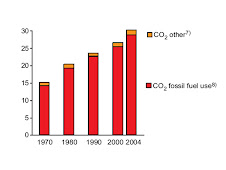
IPCC Graph #2
 In this graph, you can see the CO2 emissions have clearly increased dramatically. But, income has increased as well.
Mitigation of Climate Change IPCC Report
The beginning of this report has data on greenhouse has emissions and climate change. This will be very helpful to me when I write my paper (online), I can use this information. One amazing fact is "Between 1970 and 2004, global emissions of CO2, CH4, N2O, HFCs, PFCs and SF6, weighted by their global warming potential (GWP), have increased by 70%..."This statistic, in my final, can be the basis for answering my question. With these overwhelming numbers, why aren't people making big changes in the way they live?
"Relevant literature implies that policies and measures may induce technological change. Remarkable progress has been achieved in applying approaches based on induced technological change to stabilisation studies; however, conceptual issues remain. In the models that adopt these approaches, projected costs for a given stabilization level are reduced; the reductions are greater at lower stabilisation levels." This report, as indicated in the title, is focused on the mitigation of global warming. This quote is important for my I-Search because it tells me that technology is going to be one of the ways that climate change can be reduced. My dad has already been telling me about this: people are beginning to tele-conference instead of flying half-way around the world. This seems like one of many obvious solutions to me. But, I think the transition to this stage won't be very quick because many people have always worked, and will always worked, where the main group is.
There is a very interesting table in this report that has different aspects, "sectors," of our lives--transportation, buildings, etc...--and then explains "Key mitigation technologies and
practices currently commercially available" and "Key mitigation technologies and
practices projected to be commercialized before 2030."
Why aren't people utilizing the immense amount of options that are available now? Well, first, unfortunately many are lazy and are not willing to make the changes to their lives that are required. Also, like the Canada.com resource showed me, people won't fully act until they are forced to: the law.
I will post some tables from this report. There is a lot more information in this summary. Most of it is very detailed, but it will still be very useful to me.
"Relevant literature implies that policies and measures may induce technological change. Remarkable progress has been achieved in applying approaches based on induced technological change to stabilisation studies; however, conceptual issues remain. In the models that adopt these approaches, projected costs for a given stabilization level are reduced; the reductions are greater at lower stabilisation levels." This report, as indicated in the title, is focused on the mitigation of global warming. This quote is important for my I-Search because it tells me that technology is going to be one of the ways that climate change can be reduced. My dad has already been telling me about this: people are beginning to tele-conference instead of flying half-way around the world. This seems like one of many obvious solutions to me. But, I think the transition to this stage won't be very quick because many people have always worked, and will always worked, where the main group is.
There is a very interesting table in this report that has different aspects, "sectors," of our lives--transportation, buildings, etc...--and then explains "Key mitigation technologies and
practices currently commercially available" and "Key mitigation technologies and
practices projected to be commercialized before 2030."
Why aren't people utilizing the immense amount of options that are available now? Well, first, unfortunately many are lazy and are not willing to make the changes to their lives that are required. Also, like the Canada.com resource showed me, people won't fully act until they are forced to: the law.
I will post some tables from this report. There is a lot more information in this summary. Most of it is very detailed, but it will still be very useful to me.

IPCC Chart #1

This chart shows temperature increases all over the world, and where the physical and biological changes will occur.


Wednesday, January 30, 2008
IPCC Impacts, Adaptation, and Vulnerability
The focus of this report is on "current scientific understanding of the impacts of climate change on natural, managed and human systems, the capacity of these systems to adapt and their vulnerability." Although this does not directly correlate to my question, I think that I can learn a lot from it.
One of the main conclusions of this report is "Observational evidence from all continents and most oceans shows that many natural systems are being affected by regional climate changes, particularly temperature increases." This will directly effect human actions and cost, which is addressed a little later in the summary: "In the aggregate, however, net effects will tend to be more negative the larger the change in climate." This point is another aspect to the answer of my question. I realized this before, but now I am getting an idea of what it is going to take for global warming to become the central cultural issue of my generation.
The IPCC found that adaptation has been occurring. But, more will be required. Our "vulnerability" will depend on how quickly we act and adapt. This fact is a key point for my I-Search. I will post two tables that were in the report that are very interesting.


One of the main conclusions of this report is "Observational evidence from all continents and most oceans shows that many natural systems are being affected by regional climate changes, particularly temperature increases." This will directly effect human actions and cost, which is addressed a little later in the summary: "In the aggregate, however, net effects will tend to be more negative the larger the change in climate." This point is another aspect to the answer of my question. I realized this before, but now I am getting an idea of what it is going to take for global warming to become the central cultural issue of my generation.
The IPCC found that adaptation has been occurring. But, more will be required. Our "vulnerability" will depend on how quickly we act and adapt. This fact is a key point for my I-Search. I will post two tables that were in the report that are very interesting.
IPCC Source
I read the IPCC's (Intergovernmental Panel on Climate Change) report for 2006. I looked at the general data section for my I-Search last year. Now, on the IPCC's website, they have the newest report. There are three different major subjects: "The Physical Science Basis," "Impacts, Adaptation, and Vulnerability," and "Mitigation of Climate Change." Although I am planning on including a brief overview of global warming in my I-Search, the last two sections seem most relevant to my question.
For each separate report, there are separate citations. This post is for the link to these reports. I will include other posts for each report.
For each separate report, there are separate citations. This post is for the link to these reports. I will include other posts for each report.
Culture Change Web Site
This web page has many links that will lead me to a lot more information. But, generally, this site has a lot of data on the relationship between culture and climate change. There is recent climate news, articles, what people can do, what people are doing, and numerous essays and journals. This main page also describes why it is vital for people to act now.
"Global warming kills 160,000 a year already." This fact is another reason that will compel people to make a difference. This number will most certainly increase as the global temperature rises. Not only is the environment at risk, but our health is too. As global warming becomes more prevalent, people will realize that, if they don't make changes to their lives, their family and homes will be at risk.
From this page, I was able to navigate to Milan's U.N. Climate Change web page. This is more of a governmental/business/economic approach to my question. It talks about different countries and what each is doing/has done. The title on the top of this page is "The climate change negotiations as seen through the reaction to Mad Cow disease in the U.S.A." Threats to livestock and agriculture are provoking conferences . This is a very important fact, and helps me narrow down to an answer for my question.
"Global warming kills 160,000 a year already." This fact is another reason that will compel people to make a difference. This number will most certainly increase as the global temperature rises. Not only is the environment at risk, but our health is too. As global warming becomes more prevalent, people will realize that, if they don't make changes to their lives, their family and homes will be at risk.
From this page, I was able to navigate to Milan's U.N. Climate Change web page. This is more of a governmental/business/economic approach to my question. It talks about different countries and what each is doing/has done. The title on the top of this page is "The climate change negotiations as seen through the reaction to Mad Cow disease in the U.S.A." Threats to livestock and agriculture are provoking conferences . This is a very important fact, and helps me narrow down to an answer for my question.
Canada.com Global Warming Source
This source gave me a general idea of what is taking for people to change their habits. First, the article talks about government policies. "The round-table members said the new Conservative government is already heading in the right direction to follow its recommendations to reduce Canada's greenhouse gas emissions by 60 per cent by 2050 through existing and emerging technologies without hurting the economy." This action will encourage people to make a difference and act. I think this is going to be a major point in my I-Search. New laws and government awareness is going to be one of the biggest reasons for people to become motivated.
Another major point in this article is that Canadians deeply care about their natural surroundings. "The environment is something that Canadians care deeply about." People begin to act when something they love is at risk. For Canadians, this 'something' is nature. The Canadian population is willing to change their lifestyles in order to preserve what they love.
This article has taught me that leadership and personal risk are going to be part of the motivation for people to fight climate change. This is a very important point.
Another major point in this article is that Canadians deeply care about their natural surroundings. "The environment is something that Canadians care deeply about." People begin to act when something they love is at risk. For Canadians, this 'something' is nature. The Canadian population is willing to change their lifestyles in order to preserve what they love.
This article has taught me that leadership and personal risk are going to be part of the motivation for people to fight climate change. This is a very important point.
Tuesday, January 29, 2008
World and I School Source
I found an article on the World and I School database. The article focuses on whether we should care and fight global warming based on the overwhelming amount of evidence. This topic is directly related to my I-Search question. This essay has a lot of information about global warming in general. Since I wrote a paper last year about climate change, I think I am going to take a more specific and psychological approach to this subject this year. I am interested in the activism aspect of climate change. Although this source has information that is useful to me, it has also helped me realize how I want my paper to be.
My I-Search
HOW CAN GLOBAL WARMING BECOME THE CENTRAL CULTURAL ISSUE OF MY GENERATION?
I phrased my question this way because it allows me to research many different components of climate change. For example, I can explore the psychological component and what it will take for people to act. These and other sub-questions will help me answer my question. I will also explore why it is vital for my generation to take the lead in fighting global warming. This will give the foundation of my paper that all my research can be built on.
Last year, as most of you know, I wrote my I-Search on global warming. It was more of a general overview of climate change. This year, I want to dig deeper and really learn about how it can become the main issue in our culture today. The evidence of global warming clearly shows astonishing trends that, in a few decades, will be irreversible. We need to act now. But, even in the presidential debates, the environment rarely comes up. This is very frustrating to me. I do not understand why it is taking people so long to realize that simple changes in their lives can make a huge difference. I hope that, by writing this paper, I will have a better idea of why climate change is not yet the biggest problem in our culture today.
I already knew what I wanted my question to be before I started to research. So, I tried to find sources that gave me information that related to my topic. I thought there wasn't going to be much at first. But, I realized that there is a lot of great resources that pertain to my subject. Also, I know many people whom I could interview. They would be able to give me unique perspectives on my topic and help me answer my main question.
This subject thoroughly interests, motivates, and inspires me. I want to write about climate change so that others can learn and make a difference.
I phrased my question this way because it allows me to research many different components of climate change. For example, I can explore the psychological component and what it will take for people to act. These and other sub-questions will help me answer my question. I will also explore why it is vital for my generation to take the lead in fighting global warming. This will give the foundation of my paper that all my research can be built on.
Last year, as most of you know, I wrote my I-Search on global warming. It was more of a general overview of climate change. This year, I want to dig deeper and really learn about how it can become the main issue in our culture today. The evidence of global warming clearly shows astonishing trends that, in a few decades, will be irreversible. We need to act now. But, even in the presidential debates, the environment rarely comes up. This is very frustrating to me. I do not understand why it is taking people so long to realize that simple changes in their lives can make a huge difference. I hope that, by writing this paper, I will have a better idea of why climate change is not yet the biggest problem in our culture today.
I already knew what I wanted my question to be before I started to research. So, I tried to find sources that gave me information that related to my topic. I thought there wasn't going to be much at first. But, I realized that there is a lot of great resources that pertain to my subject. Also, I know many people whom I could interview. They would be able to give me unique perspectives on my topic and help me answer my main question.
This subject thoroughly interests, motivates, and inspires me. I want to write about climate change so that others can learn and make a difference.
Subscribe to:
Posts (Atom)